One discussion that comes up again and again in enterprise AI is model selection. Teams spend a lot of time comparing GPT with Claude, debating closed source versus open source models, and discussing whether a larger context window will make a noticeable difference.
Those are all useful questions, but they are rarely the first thing I worry about anymore. A more practical question is whether the assistant can actually see the information it needs to give a reliable answer in the first place.
That became much clearer to me while working on API centric systems rather than purely AI systems. In enterprise environments, information is rarely stored in one clean and perfectly maintained location. It is spread across API specifications, internal services, configuration files, runbooks, product documentation, tickets, databases, and sometimes even knowledge that exists only in the heads of a few experienced engineers.
The bigger problem is that all of these sources do not evolve at the same speed. An API specification might be updated today while the documentation still reflects behavior from three months ago. A configuration file may contain the latest value, while an internal wiki page still shows an older setup. Two sources can both look official and still disagree with each other.
An LLM does not automatically solve that problem. It simply reasons over the information it receives. If that information is outdated, incomplete, duplicated, or contradictory, even a very strong model can produce an answer that sounds confident but is still wrong.
That realization has gradually changed how I evaluate AI architectures. Instead of asking only how intelligent the model is, I find myself asking a different set of questions. Where did this answer come from? Is the source still maintained? Who owns it? How quickly does it change? Can someone verify it? What happens when two sources disagree?
Interestingly, those questions sound much less like AI research and much more like ordinary software engineering.
The same pattern becomes even more important once systems become more autonomous. There is a big difference between an assistant that generates text and an assistant that can call APIs, trigger workflows, update records, or perform actions on behalf of a user.
The moment an AI system starts interacting with real enterprise systems, traditional engineering concerns immediately come back into the picture. Identity becomes important. Permissions become important. Auditability matters. Observability matters. Rollback strategies matter. Error handling matters. Failure recovery matters.
The AI component does not eliminate any of those concerns. In many cases, it actually makes them more important because the system is now capable of doing more than simply responding with text.
For example, if an assistant is only summarizing a document, a bad answer is frustrating. But if that same assistant is able to update a customer record, trigger a payment workflow, change a configuration, or invoke an internal service, the consequences of a mistake can be much more serious.
This is also why I think the concept of trust is becoming one of the most important parts of enterprise AI. Users do not just need an answer. They need confidence in how that answer was created.
A useful enterprise assistant should be able to connect its response back to reliable sources. It should ideally make it possible to understand what information influenced the answer. In sensitive use cases, there should also be a clear record of what the system did, why it did it, and which user or service authorized the action.
I also think maintenance costs are often underestimated when people talk about AI projects.
Building an impressive prototype in a few weeks is completely possible. A small team can connect an LLM to a few documents, add a retrieval layer, create a polished user interface, and produce something that looks very convincing in a demo.
Keeping that same system accurate and useful six months later is a very different challenge.
Documentation changes. APIs evolve. Business rules shift. Teams reorganize. Authentication mechanisms change. New data sources are introduced. Old ones are retired. Services are renamed. Ownership moves from one team to another.
A system that worked perfectly during the original demo can slowly become less reliable if nobody is actively maintaining the information around it.
That is why I believe enterprise AI needs to be treated as a living software system rather than a one time AI project.
There needs to be clear ownership of data sources. Teams need to understand which source should be treated as authoritative. Changes need to be tracked. Retrieval quality needs to be monitored. Permissions need regular review. Failed tool calls and incorrect responses need to be observable.
In other words, the long term success of an enterprise AI system may depend more on operational discipline than on model sophistication.
This also changes the way I think about model upgrades. A better model is useful, but replacing one model with another does not automatically fix broken context, outdated documentation, poor retrieval, weak permissions, or missing observability.
Sometimes the biggest improvement comes from fixing the information pipeline around the model rather than changing the model itself.
That is an important distinction because it is easy to assume that a smarter model will solve problems that are actually caused by the surrounding architecture.
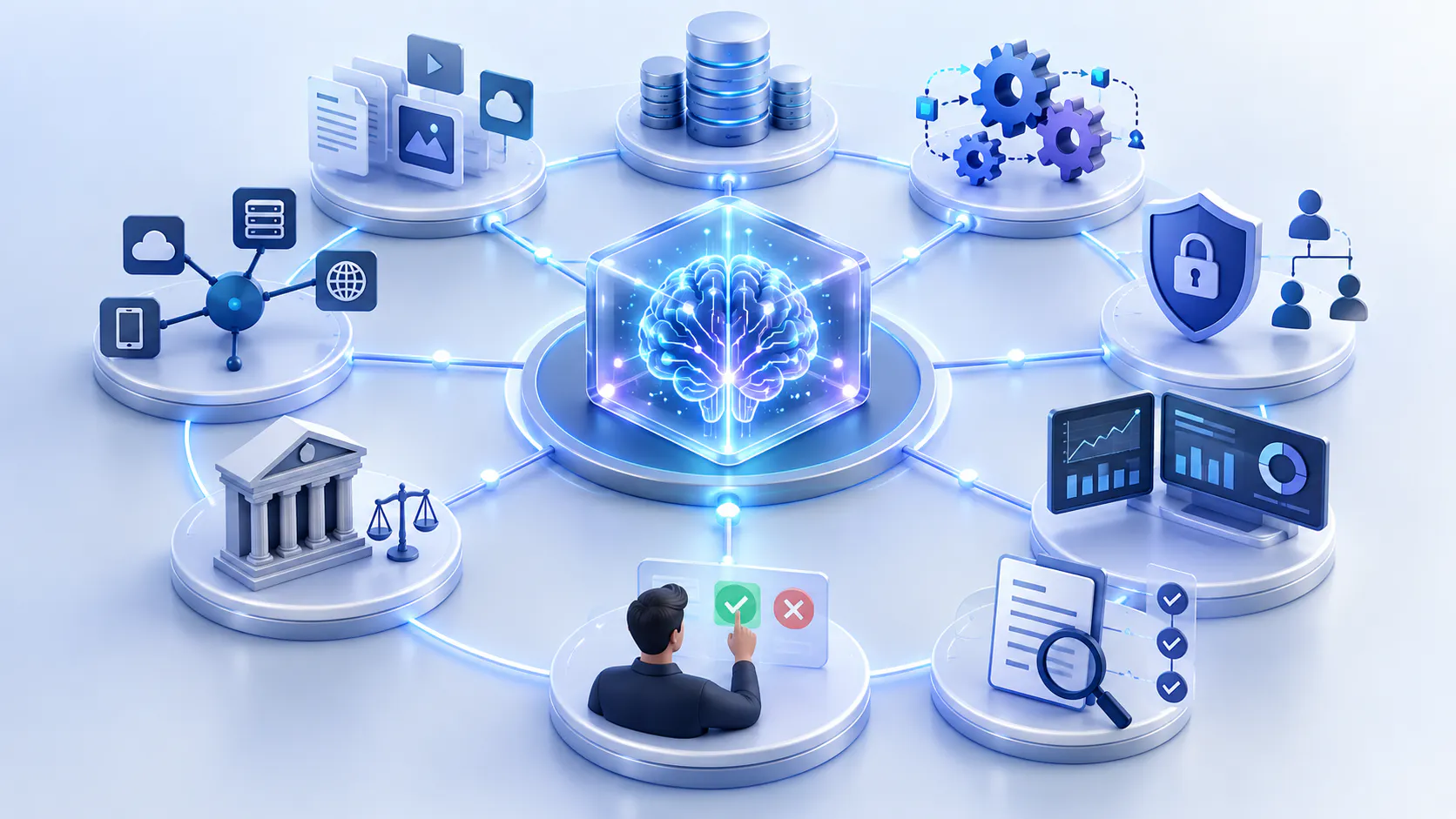
The more I work with enterprise AI, the more I believe the language model is only one part of the system. Around it sits a much larger engineering layer responsible for context, security, orchestration, governance, integration, monitoring, and reliability.
That surrounding layer is where many of the hardest engineering decisions actually happen.
So when I look at an enterprise AI architecture today, I still care about which model is being used. But I care just as much, and often more, about the systems around it.
I want to know where the information comes from, who owns it, how fresh it is, how actions are controlled, how failures are handled, and whether users can understand why the system produced a particular result.
In the end, many successful enterprise AI systems may not be judged by which model scored highest on a benchmark.
They may be judged by something much simpler.
Can people trust them?
And that trust will probably come less from the intelligence of the model itself and more from the engineering discipline of everything built around it.